Wartime booklet · 1940
From the History of War, Guaranteeing China's Certain Victory
《從戰爭的歷史上保證中國必勝》
- Compilers
- 茂芹 (Mao Qin) and 吳源興 (Wu Yuan Xing) — given name and 字 (courtesy name) of the same person
- Publisher
- 嶺南出版社 · Lingnan Publishing House
- Date
- 中華民國二十九年一月一日 · 1 January 1940
- Price
- 國幣二角 (0.20 yuan per copy)
- Length
- 21 pages (plus covers)
- Holdings
- National Library of China · 民國時期文獻 collection, shelfmark NLC416-12jh003666-43562; Chinese University of Hong Kong Library · Special Collections
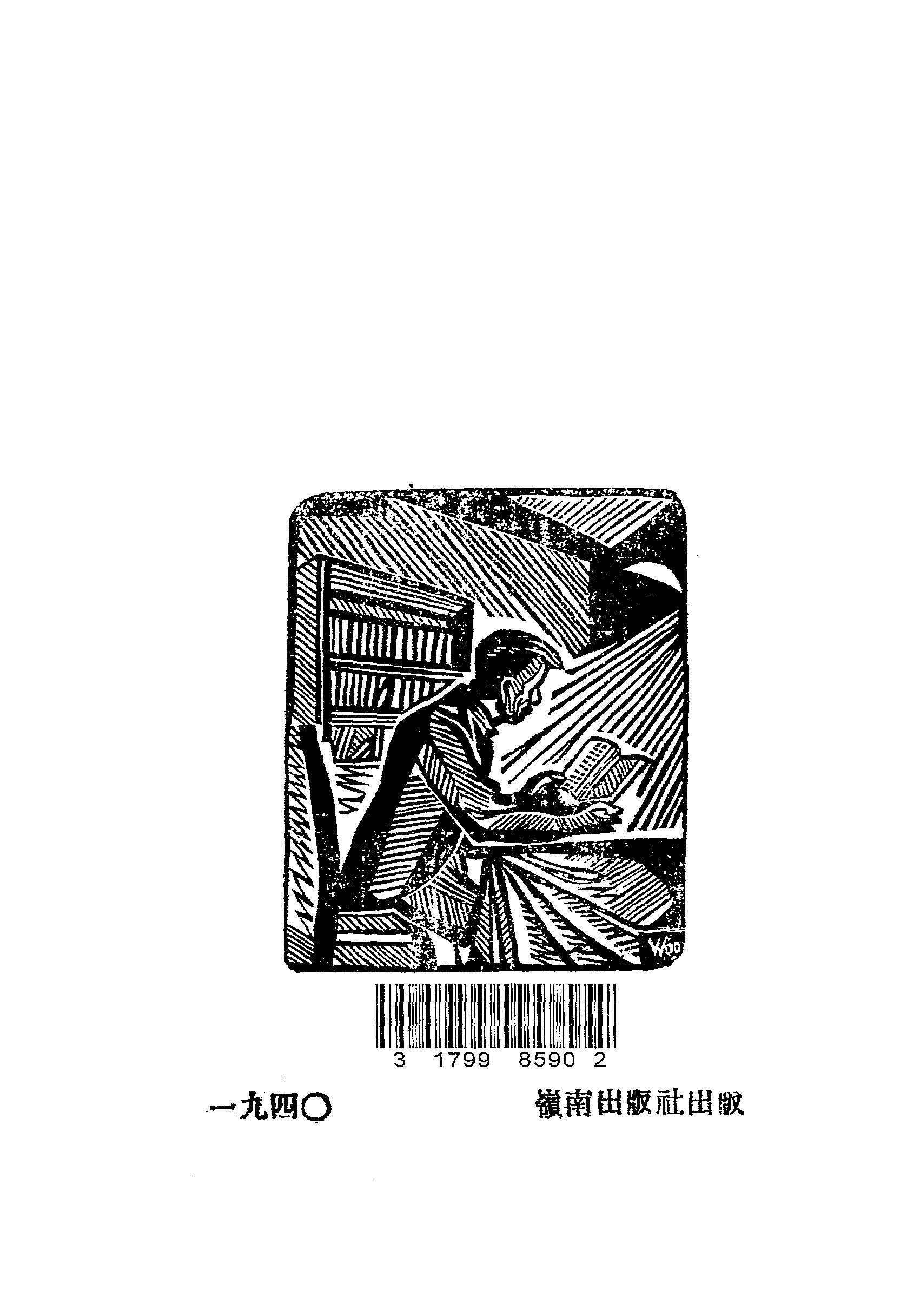
Archive holding · 民國時期文獻
Held at the National Library of China
The original 1940 imprint of 《從戰爭的歷史上保證中國必勝》 by 茂芹 吳源興 (Mao Qin / Wu Yuan Xing, 嶺南出版社) is preserved in the Republican-era (民國時期) collection of the National Library of China, shelfmark NLC416-12jh003666-43562. The photographs below show the title-page spread with the original woodcut frontispiece, and the volume on display at the library (catalogued under "Anti-Japanese War Strategy · Author: 吳源興").
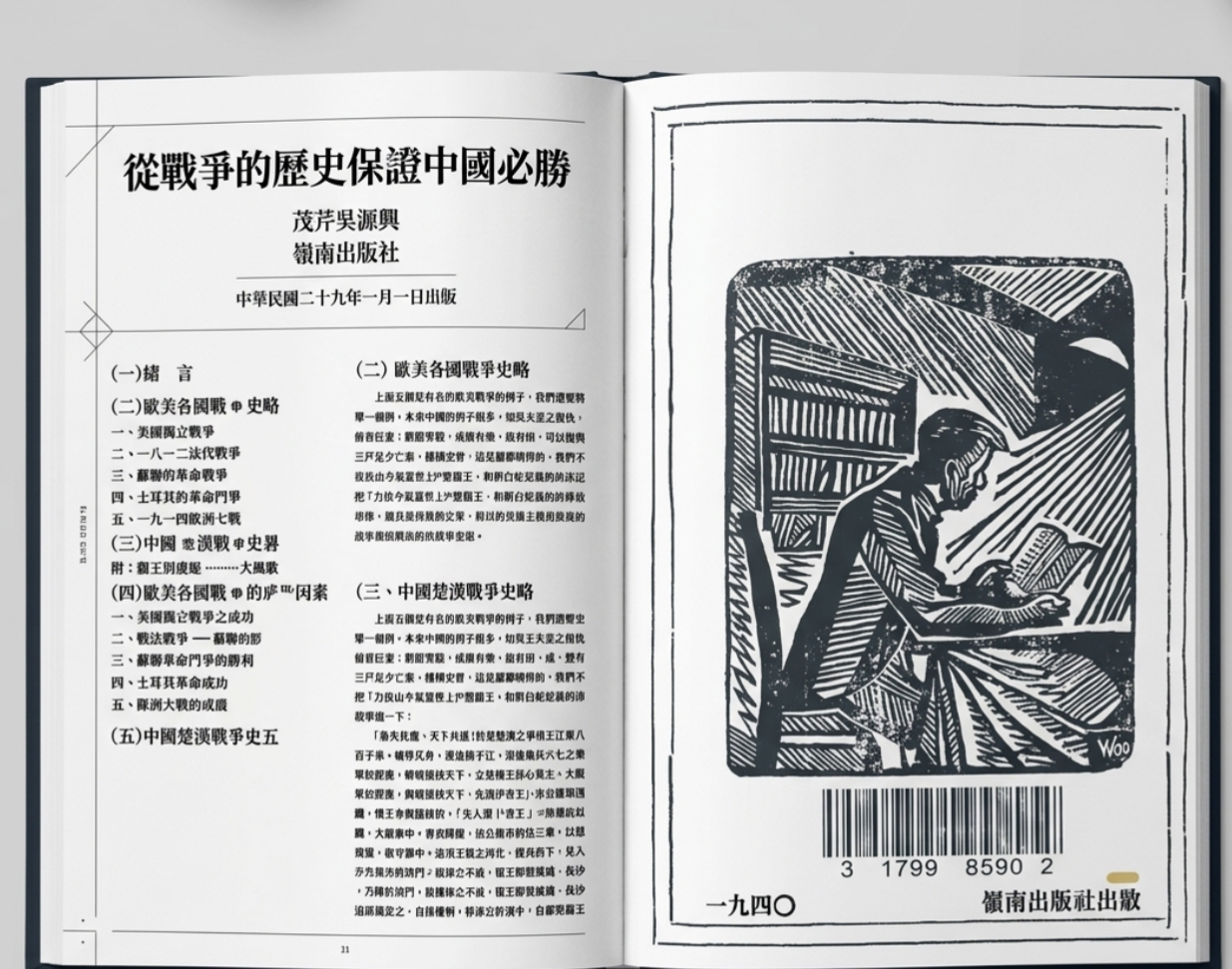
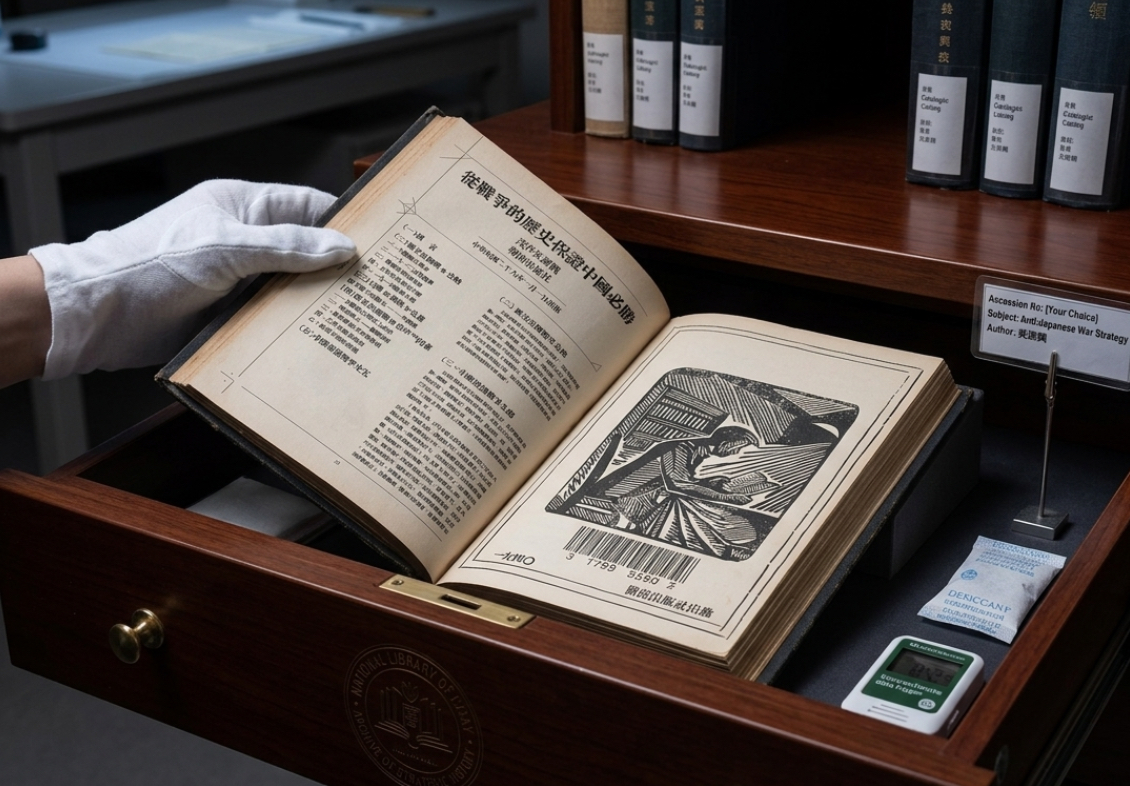
Archive holding · Special Collections
Held at the Chinese University of Hong Kong Library
The same 1940 imprint is also held in the Special Collections of the Chinese University of Hong Kong Library, preserving the booklet within the Hong Kong academic archive of Republican-era print culture and wartime publishing from the Cantonese-speaking south.
What the booklet argues
Written in the third winter of the War of Resistance and dated the first day of 1940, this is a short comparative-history pamphlet arguing one thesis: every time in modern history that a weaker country resisted an invader long enough, the invader collapsed first. China, the author insists, is now living inside that same historical pattern, and the two and a half years already survived are not a stalemate but the early proof of victory.
The method is plain: walk through five foreign wars and one Chinese civil war; for each, extract the "factors of success or failure"; then line them up, point by point, against the present Sino-Japanese War.
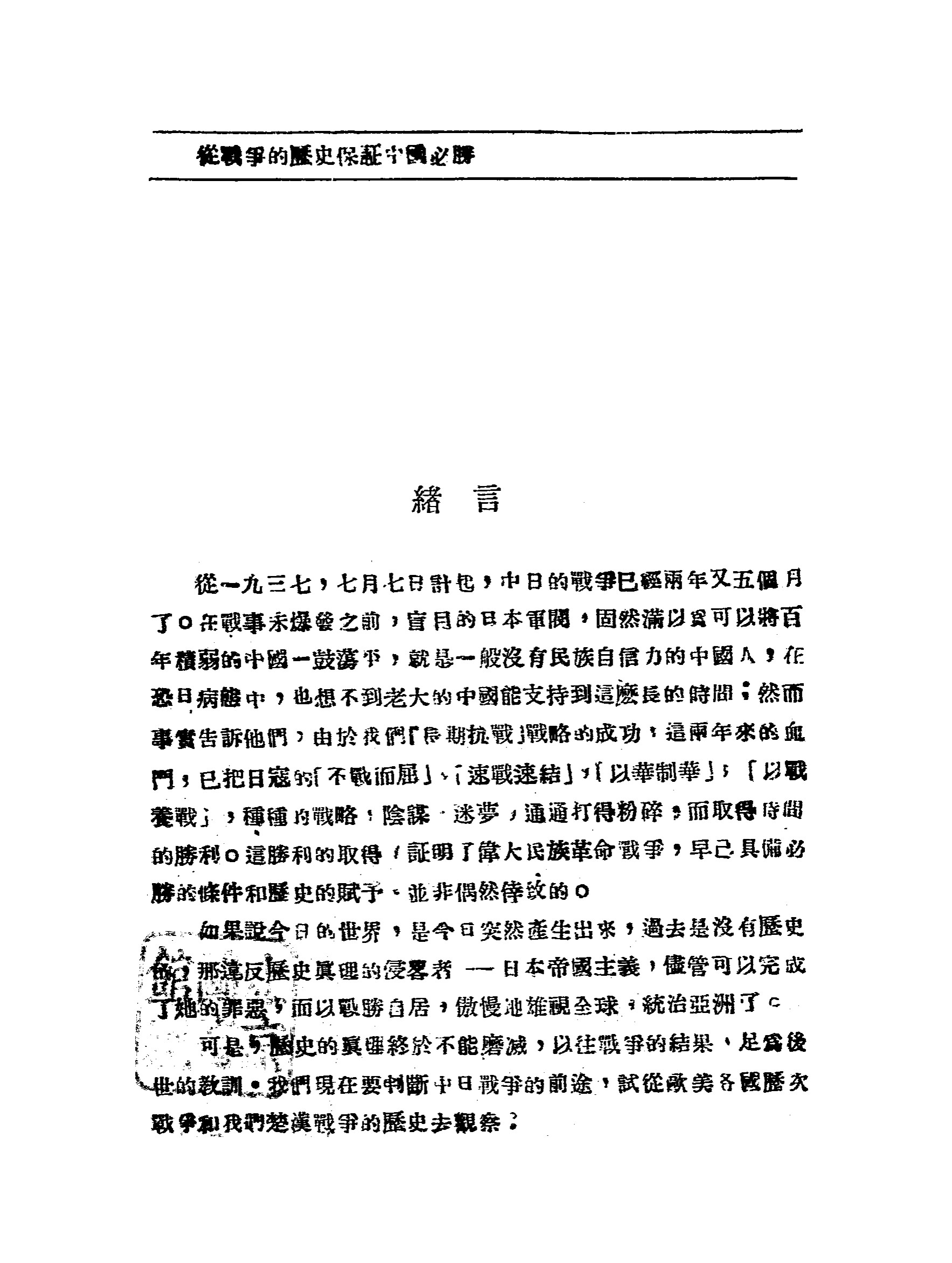
Preface · 緒言
"Counting from 7 July 1937, the war between China and Japan has already lasted two years and five months. Before it broke out, the blind Japanese militarists were convinced they could sweep aside a China weakened by a hundred years of decline in a single blow; even Chinese people who had no national self-confidence, sick with fear of Japan, never imagined the old country could hold out this long. But the facts have told them otherwise. Thanks to the success of our strategy of 'protracted resistance' (長期抗戰), the blood-fighting of these two years has shattered the enemy's every scheme — 「不戰而屈」 (bend China without fighting), 「速戰速結」 (quick war, quick finish), 「以華制華」 (use Chinese to control Chinese), 「以戰養戰」 (feed war with war) — and won us the victory of time. That victory proves that this great war of national revolution already possessed the conditions for ultimate victory and the sanction of history; nothing about it is accidental."
The preface closes with a methodological move: if today's world had no past, then Japan could write whatever ending it liked. But history is not erasable. To judge where the Sino-Japanese War is going, the author proposes, we should look at how other long wars actually ended.
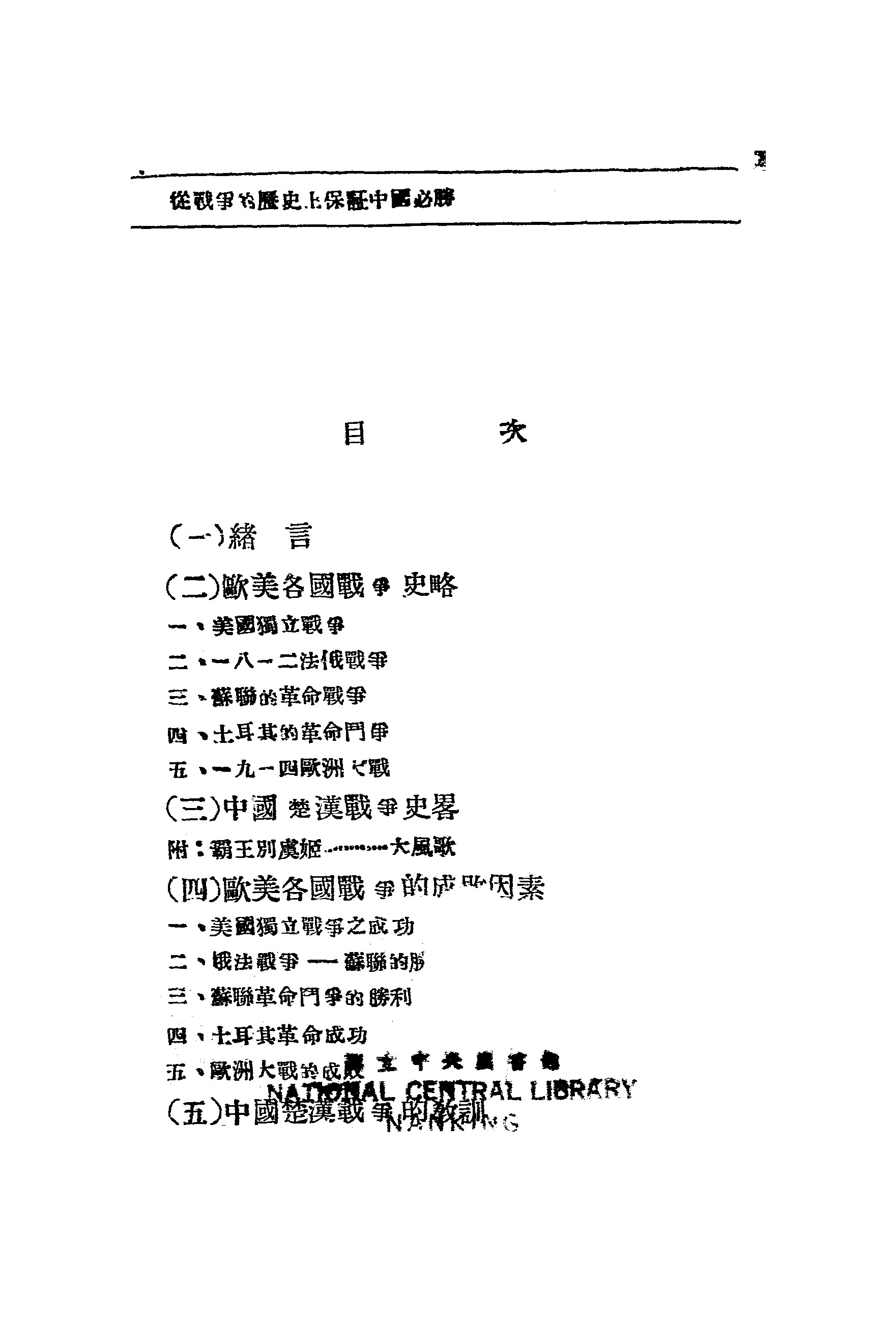
Part I — A brief history of wars in Europe and America
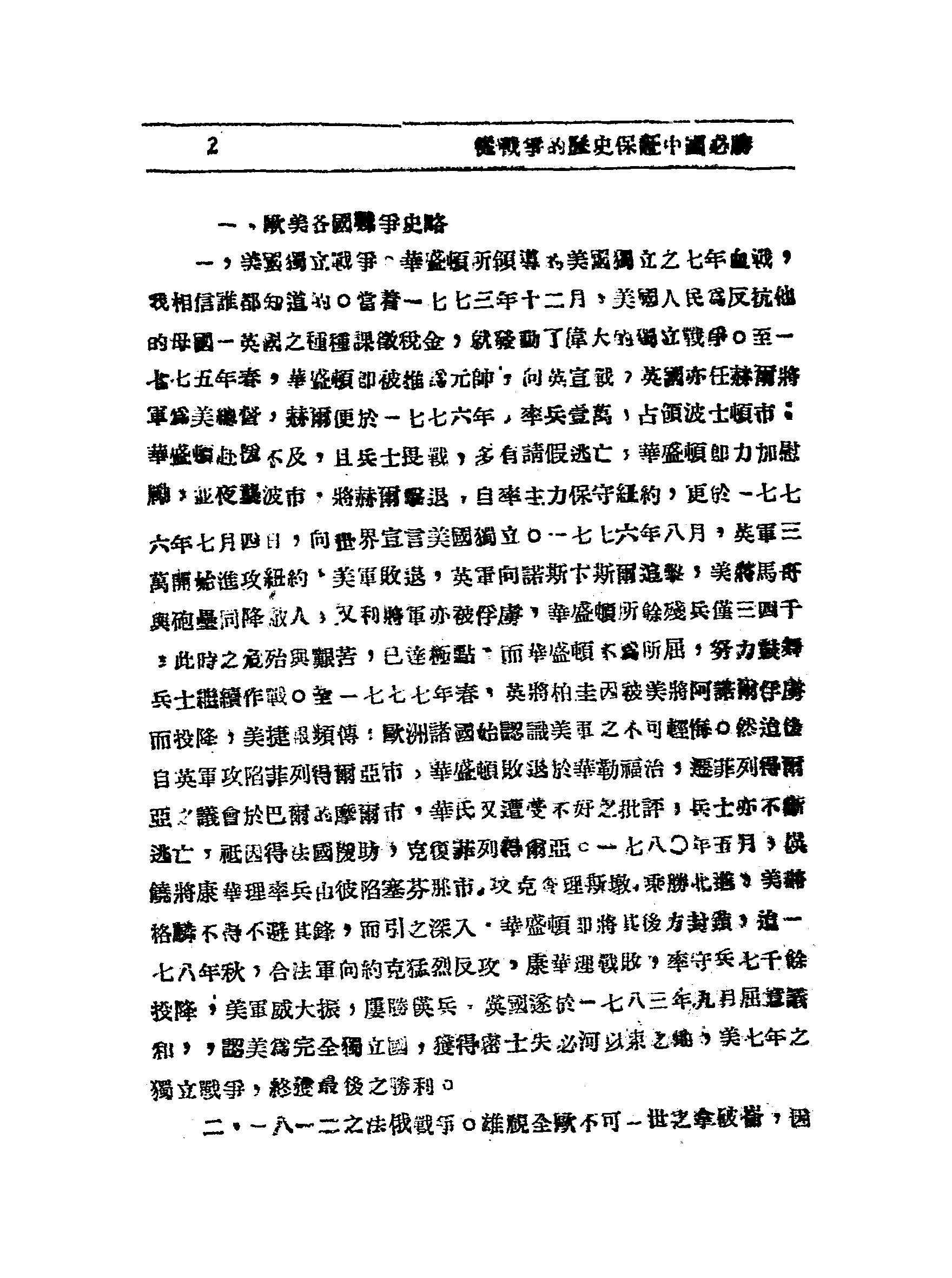
1. The American War of Independence (1775–1783)
Triggered in December 1773 by British taxation, the war is led by Washington from 1775. The British seize Boston, then New York; at the worst point Washington has only three or four thousand men left, two American generals are taken, and his own troops are deserting. He refuses to fold, raids Boston by night, holds New York with his main force, and on 4 July 1776 the colonies declare independence to the world. After the surrender of Burgoyne's forces in 1777, Europe begins to take the Americans seriously; French aid lets Washington retake Philadelphia. The decisive blow comes in autumn 1781, when a Franco-American attack on Yorktown forces Cornwallis to surrender his seven-thousand-man garrison. In September 1783 Britain sues for peace, recognises the United States as fully independent, and cedes the territory east of the Mississippi. Seven years of war end in total victory. Wu Yuan Xing presents this case first and at greatest length because he regards it as the clearest modern proof that a weaker people, fighting for its own soil and refusing to surrender, can defeat a stronger invading empire — the very argument he applies to China.
2. The Franco-Russian War of 1812
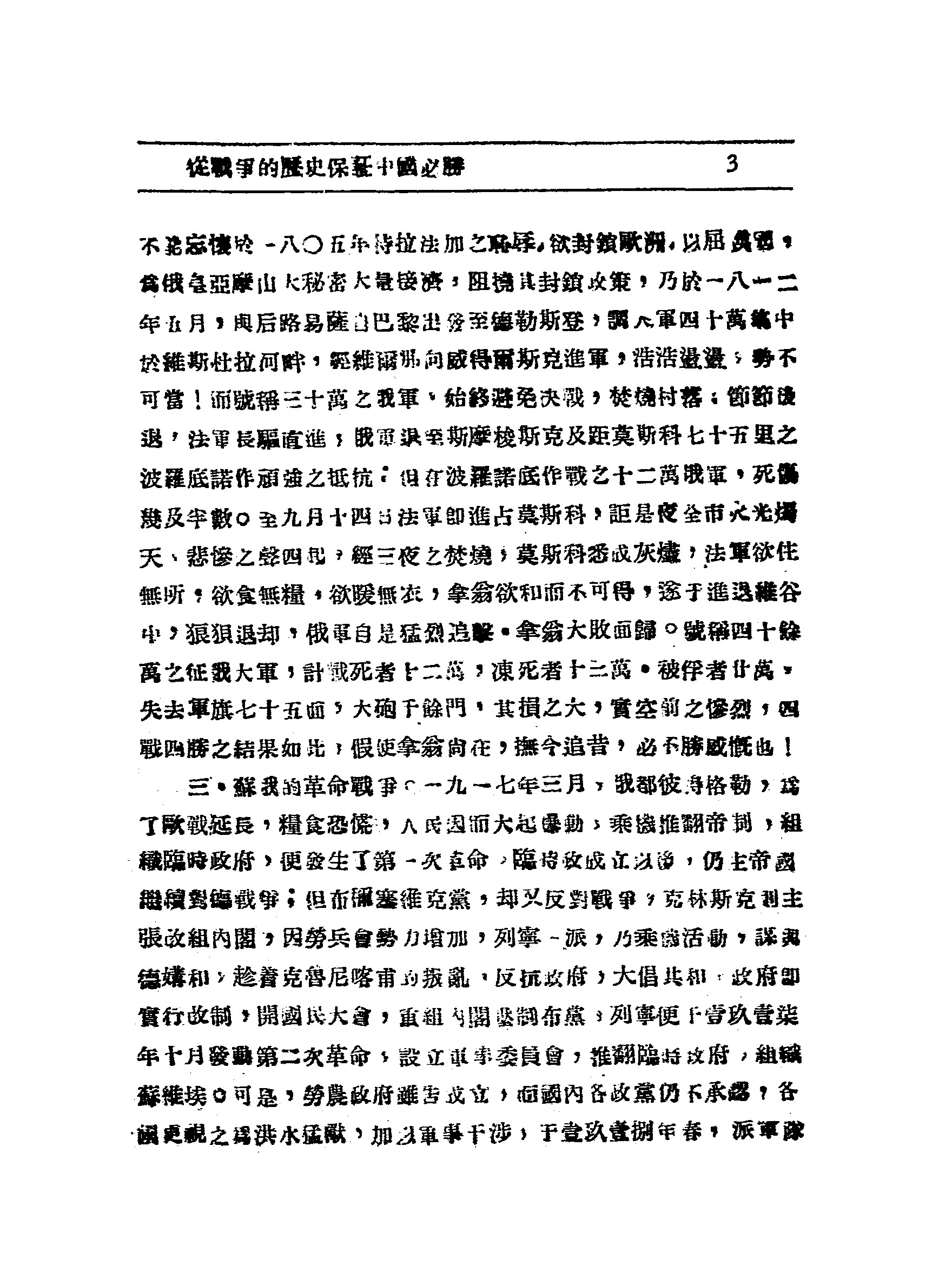
Napoleon, still smarting from Trafalgar (1805) and trying to choke Britain through the Continental System, is undermined by Tsar Alexander's covert supply of Britain. In May 1812 he marches from Paris with 400,000 men toward the Vistula and on into Russia. The Russian army — nominally 300,000 — refuses pitched battle, burns villages, falls back. The first serious stand at Borodino, 75 li from Moscow, costs the Russians nearly half of their 120,000 engaged; on 14 September Napoleon enters Moscow. That night the city goes up in flames. Three nights of fire leave the Grande Armée with no shelter, no food, no warm clothing, and no one to negotiate with. The retreat becomes a rout: of the 400,000 who set out, 120,000 are killed in battle, 120,000 freeze to death, 200,000 are captured, 75 standards and over a thousand cannon are lost. "Four campaigns, four victories — and this is the result."
3. The Soviet revolutionary war (1917–1921)
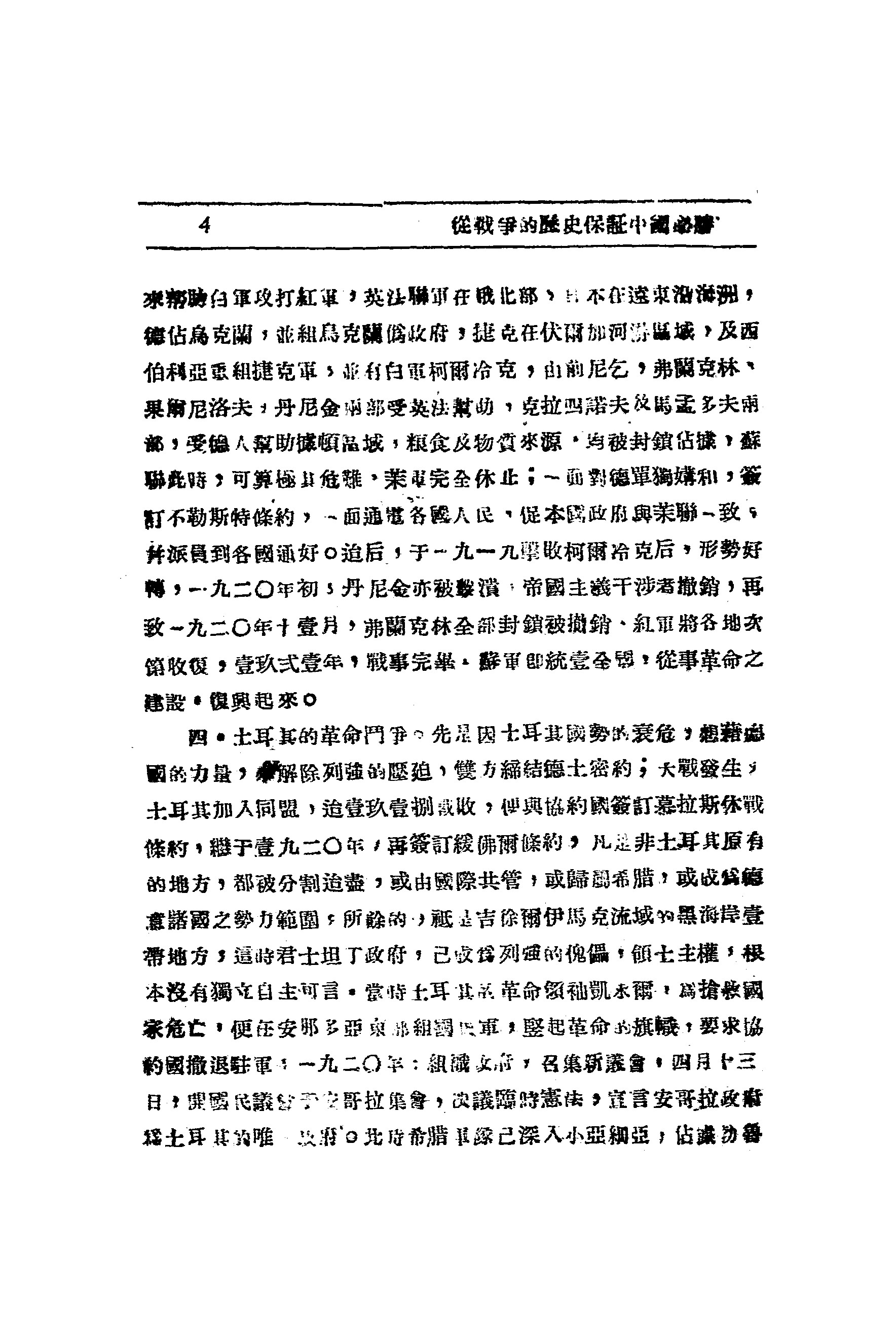
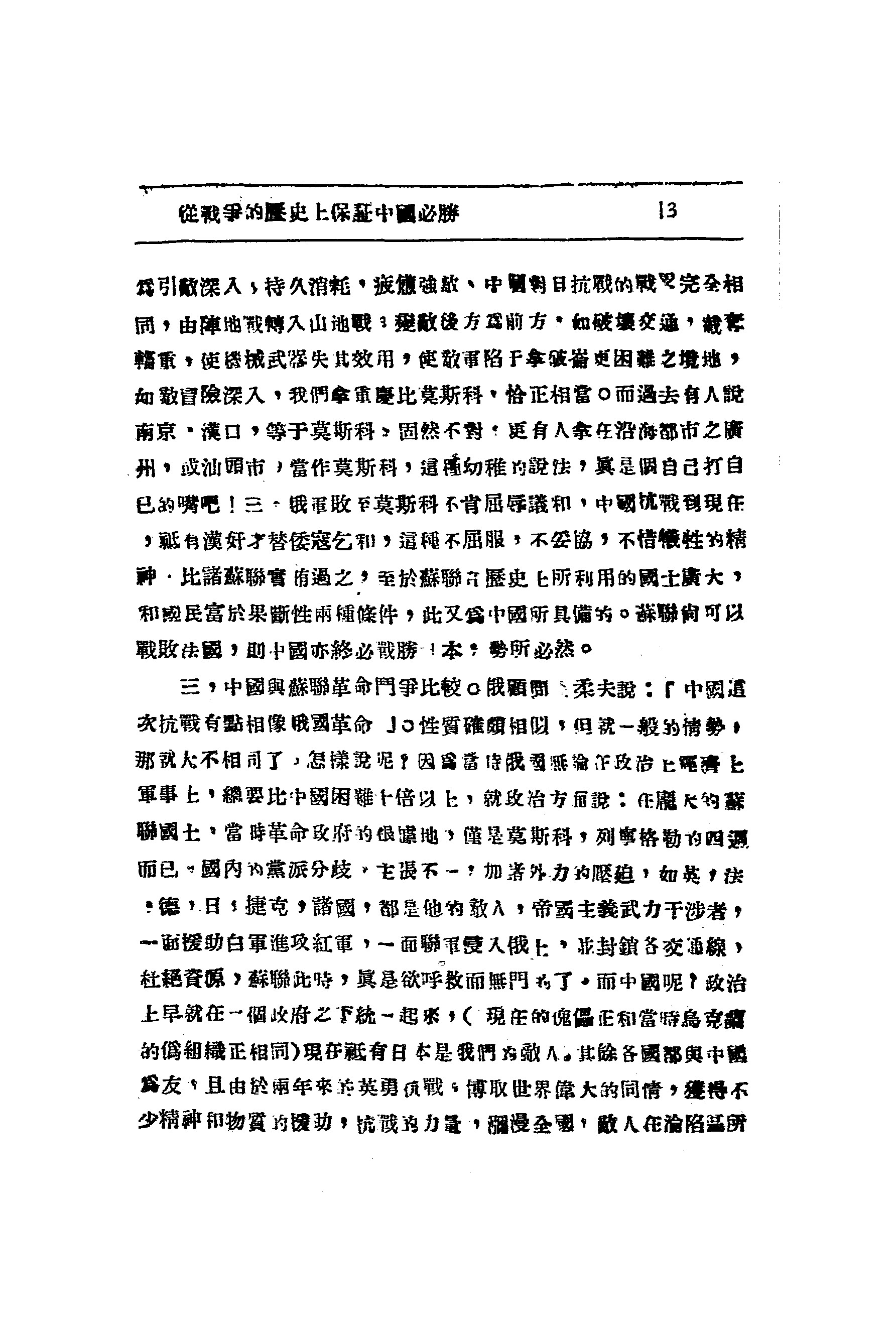
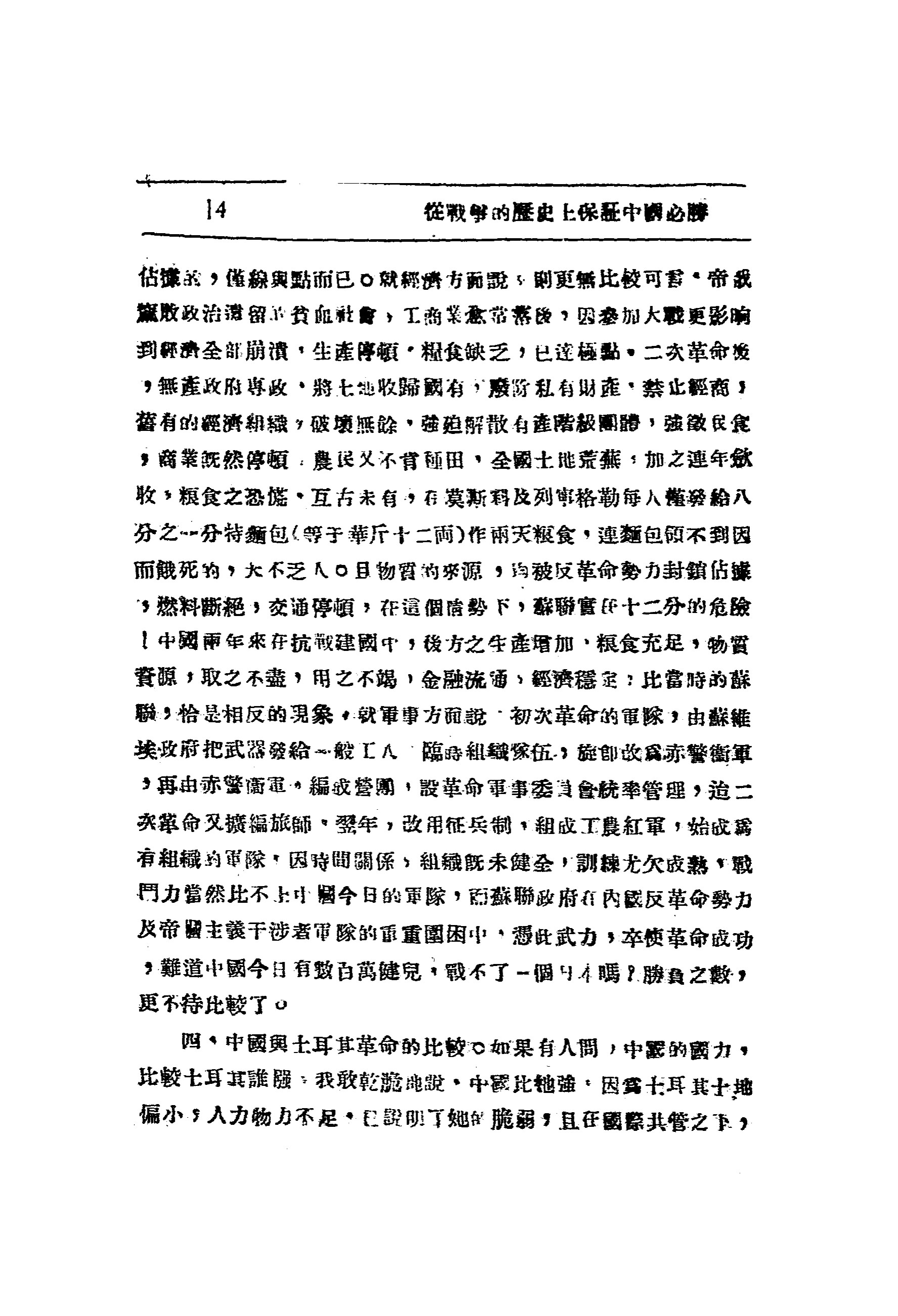
Petrograd's bread riots of March 1917 topple the Tsar; the Provisional Government wants to keep fighting Germany, the Bolsheviks oppose the war. In October 1917 Lenin's second revolution sets up the Soviets. The young Soviet state then has to fight on every front at once: British and French troops in the north, Japanese in the Far East, Germans occupying Ukraine and propping up a puppet government there, the Czech Legion on the Volga and in Siberia, and the White generals — Kolchak, Denikin, Wrangel, Krasnov, Mamontov — backed variously by London, Paris and Berlin. Supplies are blockaded; the regime looks done for. It survives by signing the separate peace at Brest-Litovsk to buy time, appealing over the heads of foreign governments to their workers, and grinding the interventionists down one by one: Kolchak in 1919, Denikin in early 1920, Wrangel by November 1920. By 1921 the war is over and the Soviet Union sets about reconstruction.
4. The Turkish revolutionary struggle (1919–1923)
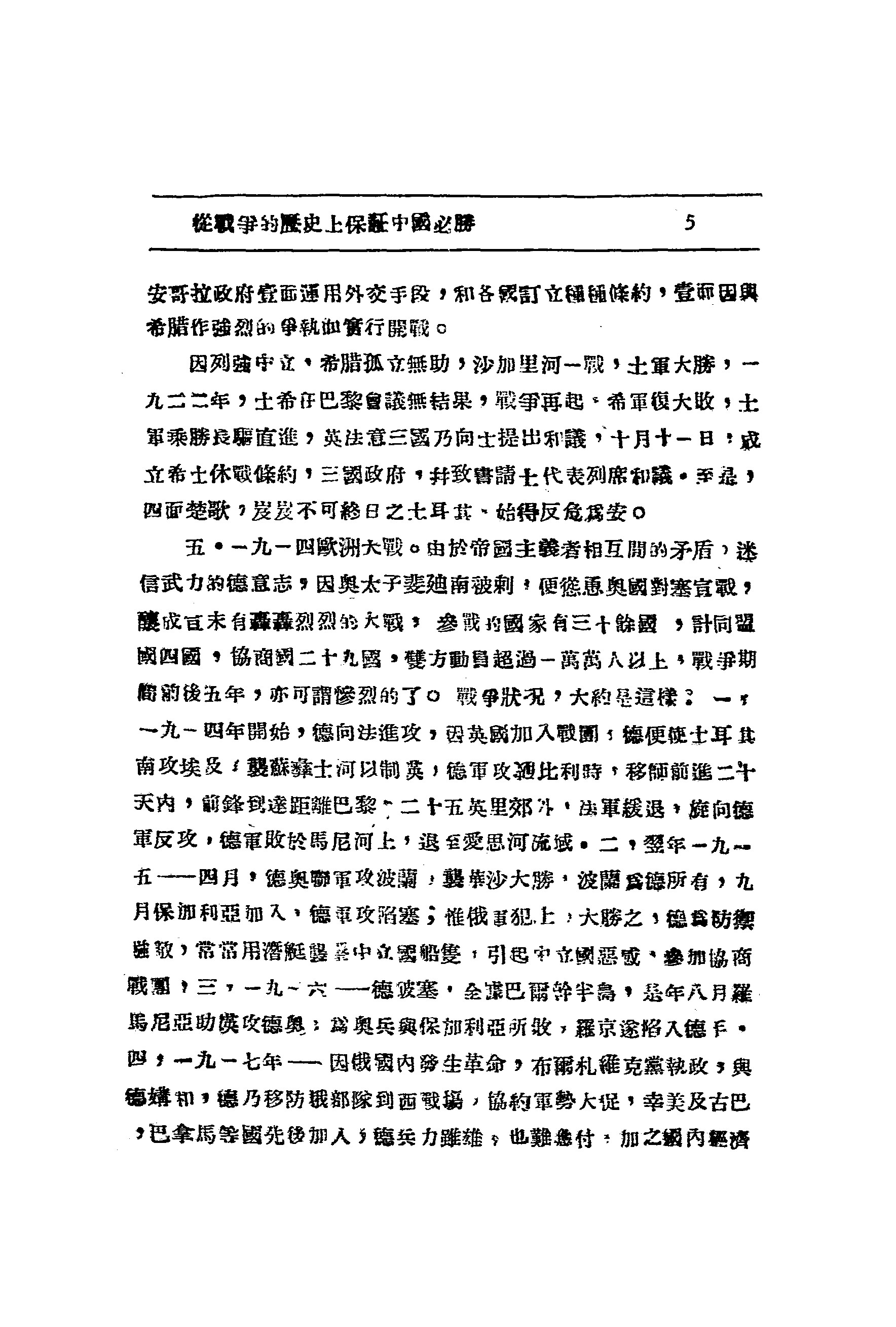
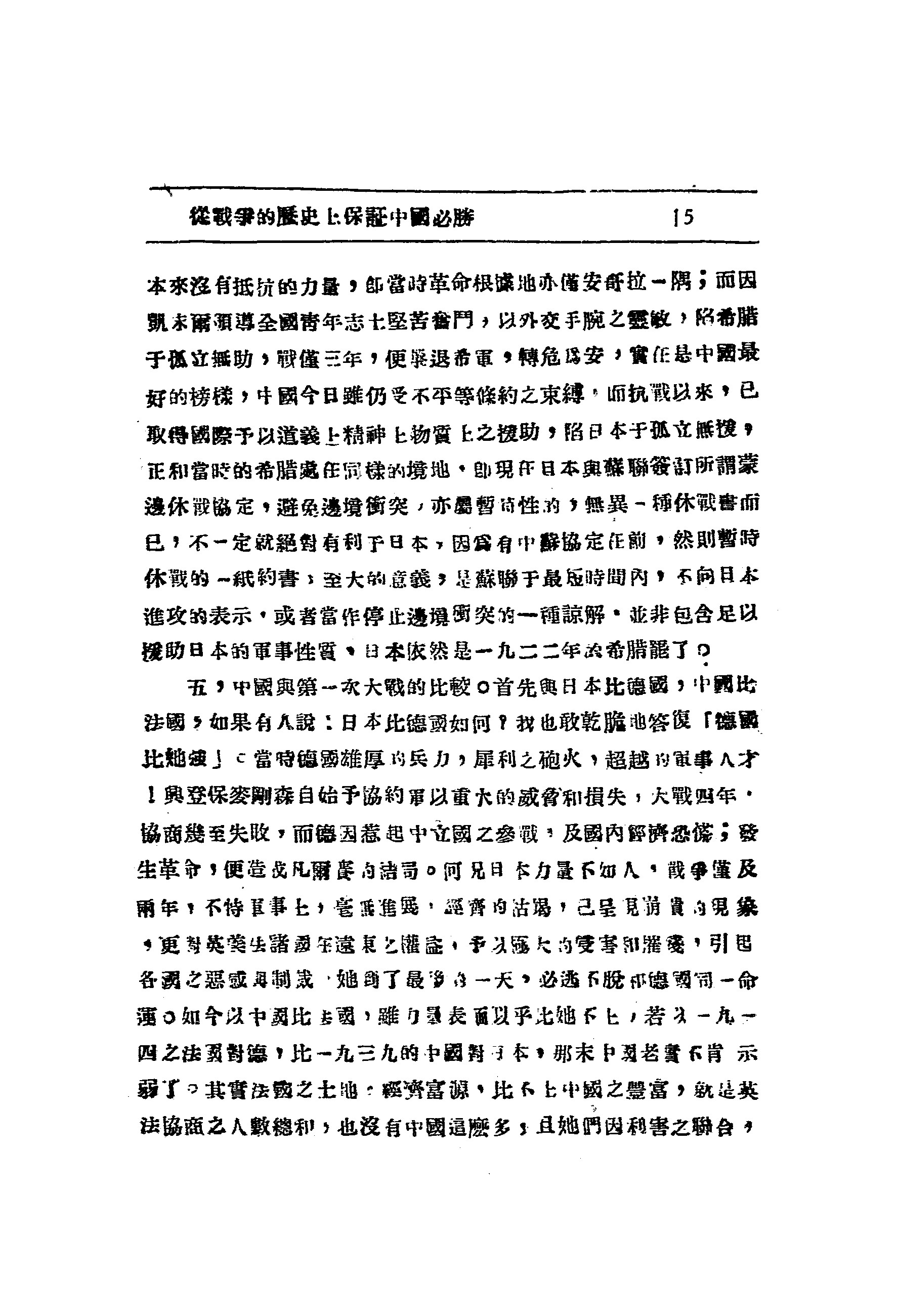
Ottoman Turkey, defeated in 1918, signs the Armistice of Mudros and then the punitive Treaty of Sèvres (1920): non-Turkish territories are stripped away, the rest carved into international administration, Greek and Italian zones, and the Constantinople government is reduced to a puppet of the Allies. Mustafa Kemal organises a national army in eastern Anatolia, demands withdrawal of foreign forces, convenes a new parliament at Ankara on 13 April 1920, declares it the only legitimate Turkish government, and goes to war with the Greek army then driving deep into Asia Minor. Through a combination of military victory and diplomatic isolation of Greece, Turkey wins back its sovereignty.
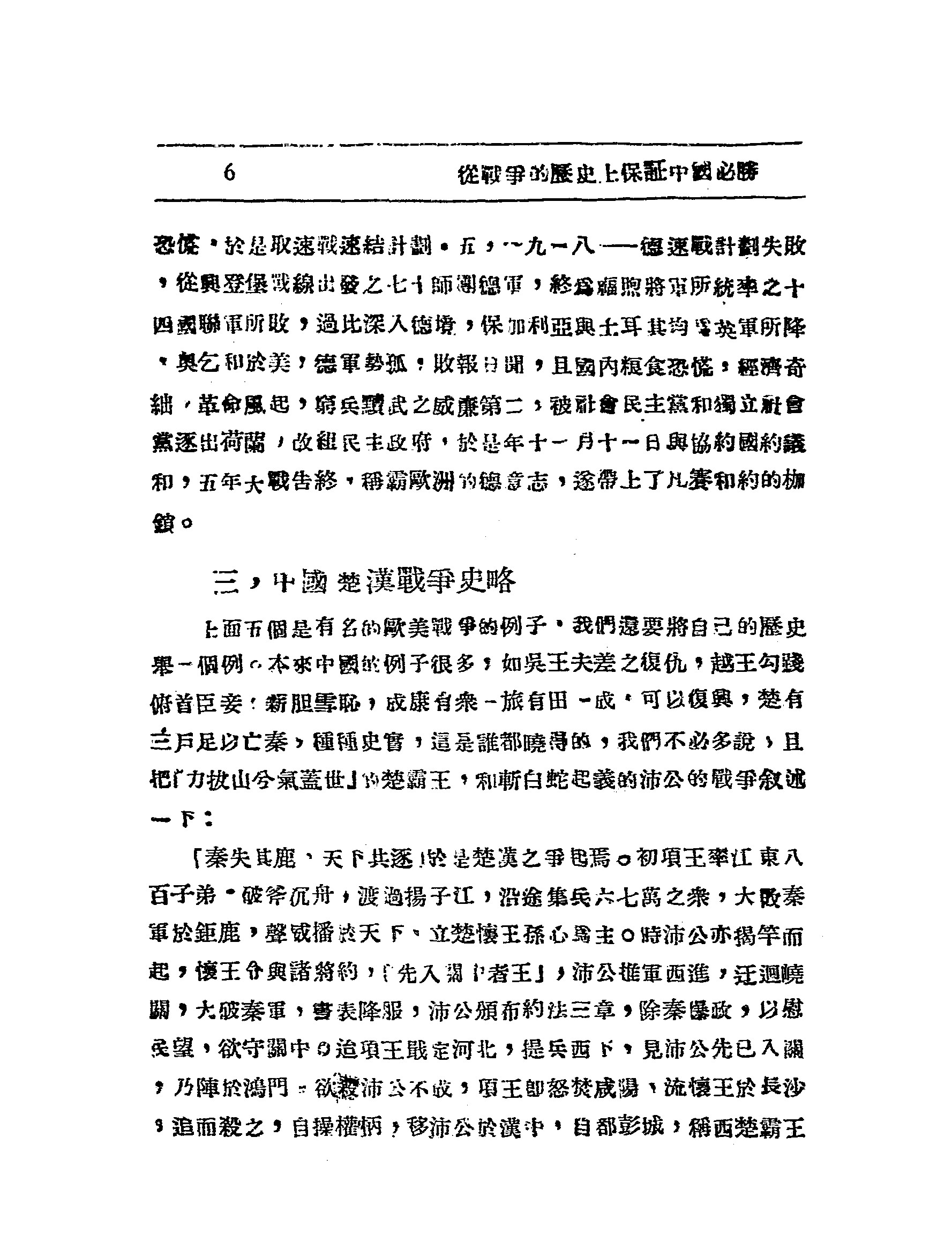
5. The European War of 1914 (First World War)
Treated in the booklet as the case where the will to endure was uneven across the alliance — Russia, for instance, made a separate peace in 1917 — yet the Allies still survived the crisis around Paris, broke through the dark year of 1917, and won. The author uses 1914–1918 to make a hard point: even an allied coalition with weaker resolve in places can prevail if it does not collapse, because Germany's calculation of victory depended on Allied collapse, not on its own strength alone.
Part II — China's Chu–Han contention (楚漢戰爭)
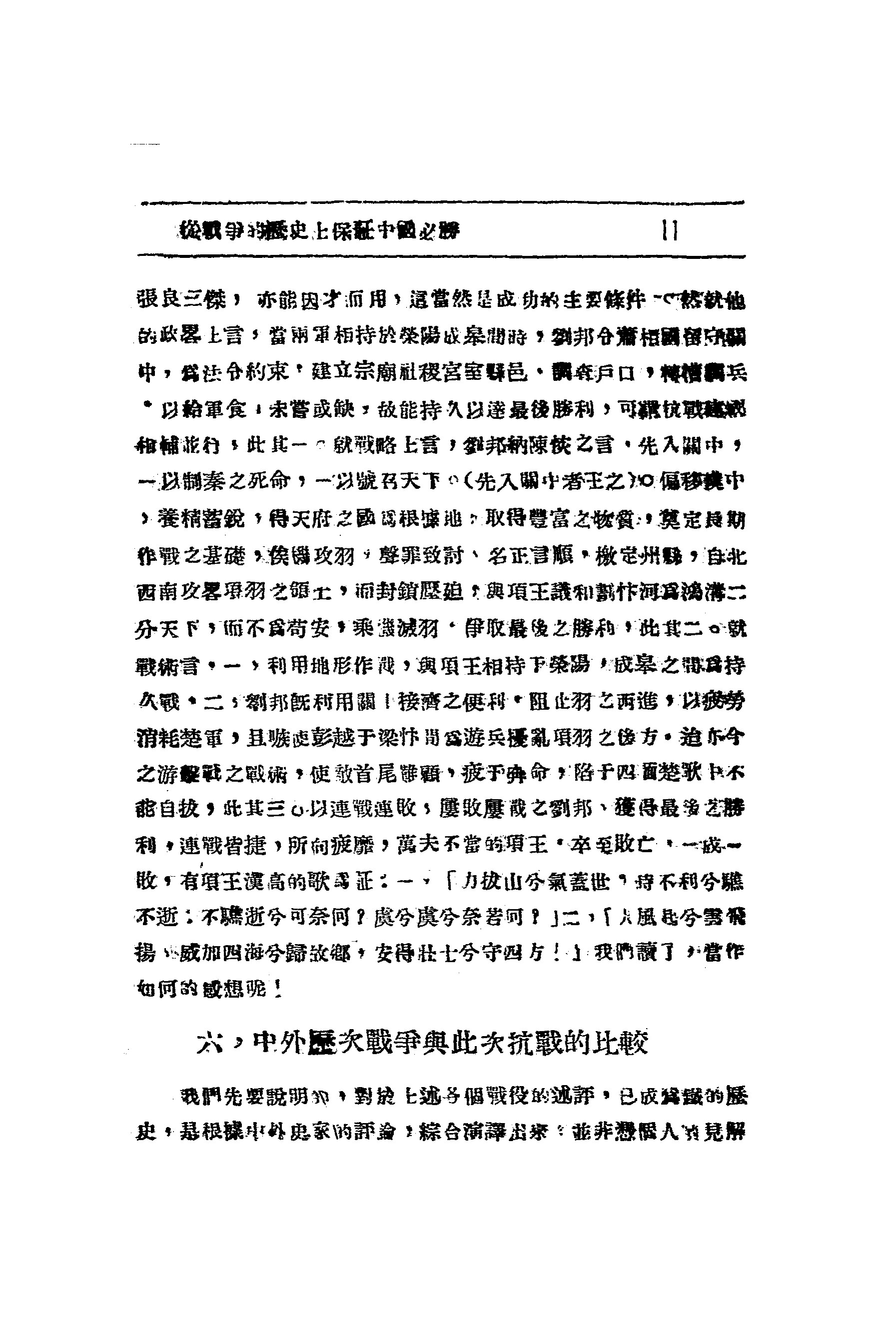
The author then turns to China's own history and the war between Xiang Yu of Chu and Liu Bang of Han (206–202 BC). The chapter includes, as appendices, two of the most famous Chinese-language war poems: 霸王別虞姬("The Overlord's farewell to Lady Yu"), Xiang Yu's lament on the night of his final defeat, and 大風歌 ("The Song of the Great Wind"), Liu Bang's victor's anthem. The lesson the author extracts is the inverse of the foreign cases: Xiang Yu had every initial advantage and still lost — because he could not wait, could not absorb setbacks, and squandered the moral support of the people. The Chu–Han war is offered as the indigenous Chinese proof of the same rule the European wars demonstrate.
Part III — Why those wars were won (or lost)
The middle chapters extract the "success factors" of each case and state them as general rules:
- America (1775–83): a defender who refuses to be destroyed even when reduced to a few thousand men, plus a willingness to accept foreign help on his own terms, outlasts an empire fighting at the end of a long supply line.
- Russia (1812): trading space for time, scorched earth, and refusing decisive battle destroys an invader at the moment of his apparent triumph; winter and starvation do what no army could.
- Soviet Russia (1917–21): a defender encircled by multiple foreign interventions can still win if it (a) buys time with diplomacy, even at the cost of humiliating treaties, (b) appeals over the heads of hostile governments to their own peoples, and (c) defeats the interventionists piecemeal rather than all at once.
- Turkey (1919–23): a country whose central government has become a foreign puppet can still recover sovereignty if a national movement organises outside the capital, declares itself the only legitimate authority, and fights.
- World War I: alliances do not need uniform resolve to win — they need the side with less resolve not to collapse before the other side runs out of breath.
- Chu–Han contention: initial military superiority is not destiny; arrogance, impatience, and loss of popular support turn an apparent winner into a final loser.
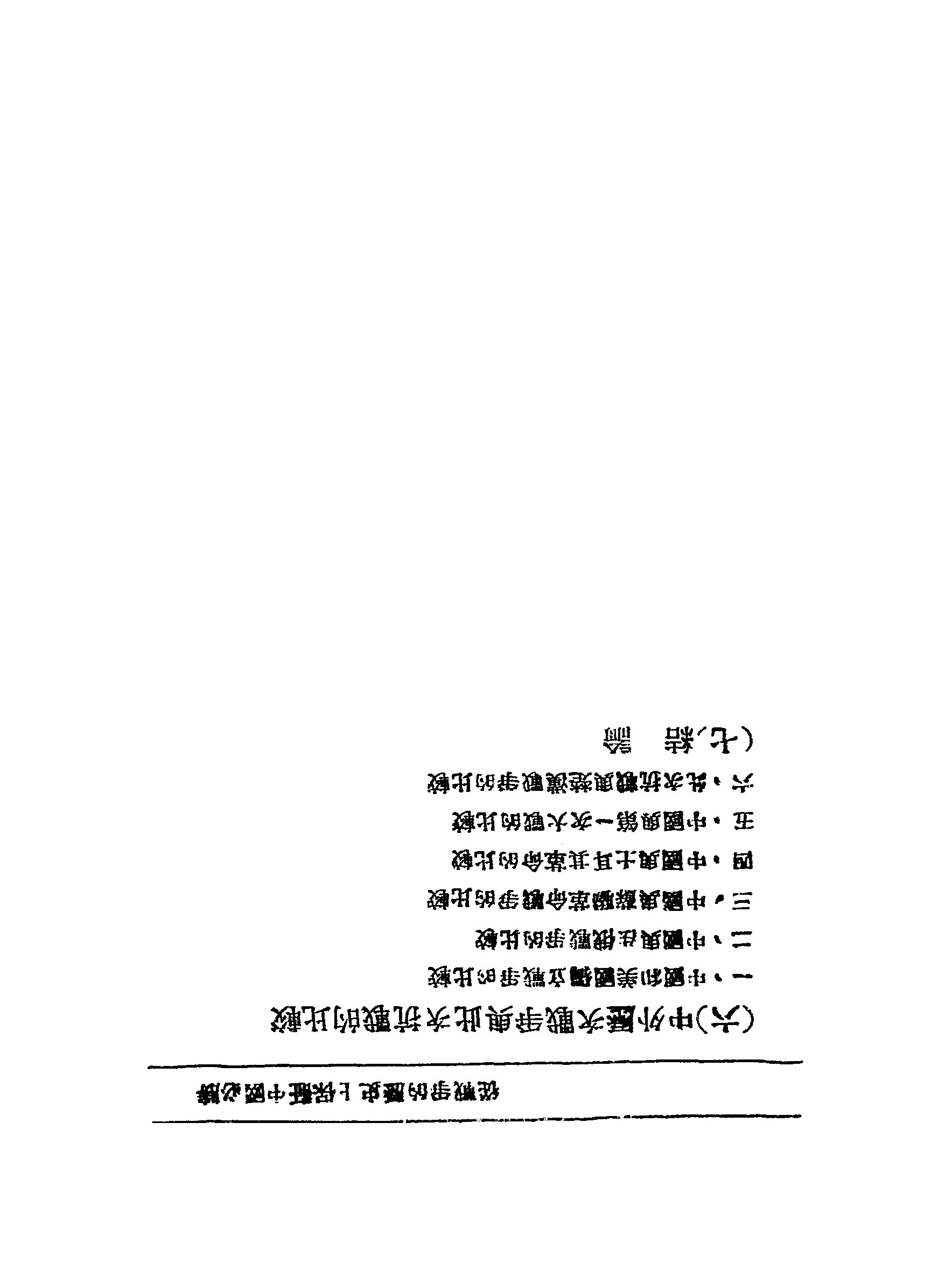
Part IV — Six comparisons with the present War of Resistance
This is the spine of the booklet. The author insists his readings of these wars are not personal opinion but "iron history" distilled from Chinese and Western historians; the reader is asked to accept the comparisons in that spirit and draw the rational judgement.
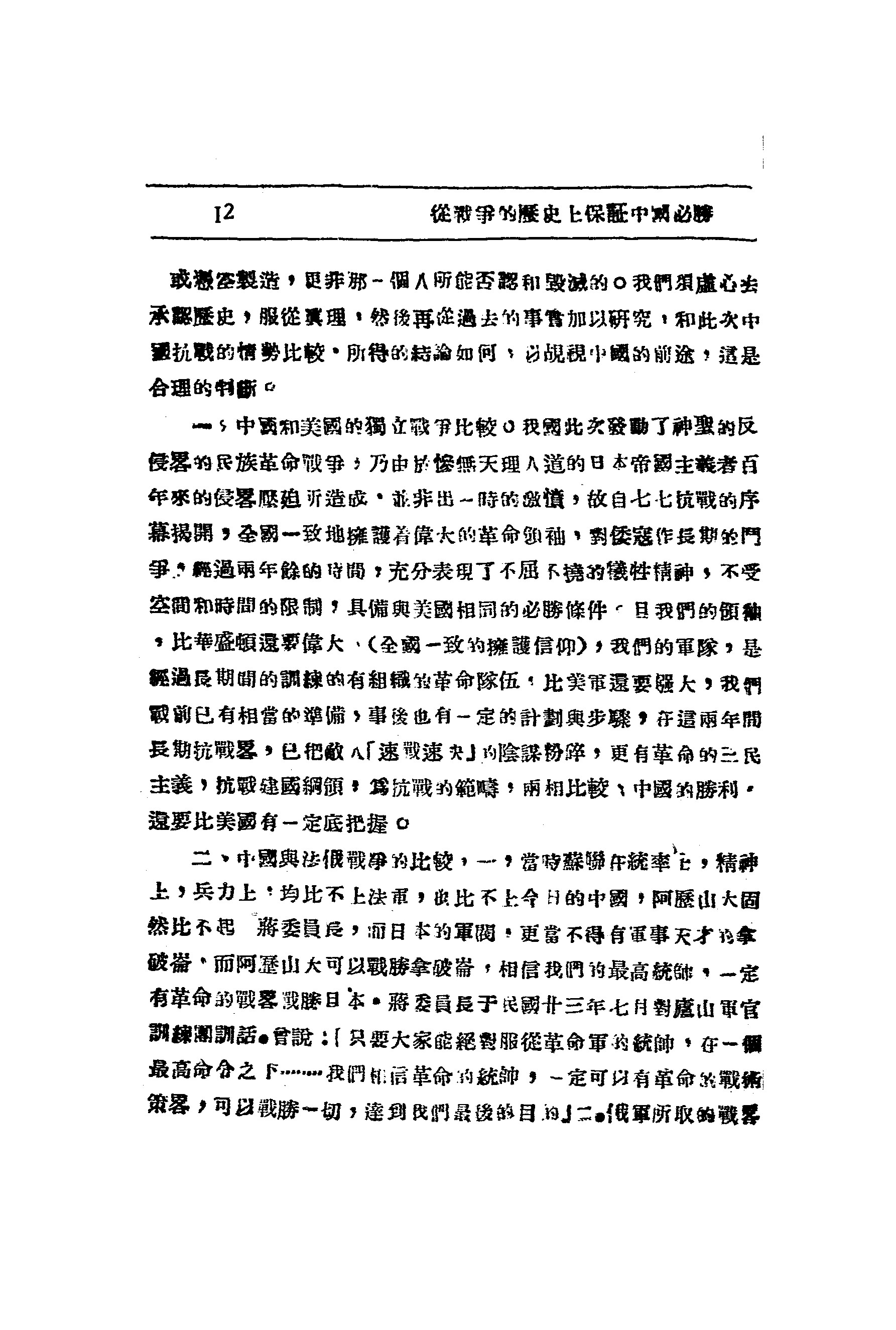
- vs. America 1775–83. China in 1939 is in a stronger position than the thirteen colonies were: vastly larger population, far more territory, and a unified national government from the outset (rather than colonies inventing one mid-war). If Washington's handful of men could outlast Britain, China can outlast Japan.
- vs. France–Russia 1812. Japan's invasion of China is the Napoleonic march into Russia repeated at industrial scale. The Japanese army is operating far from its home base across hostile country; the Chinese strategy of trading space for time is the same instrument that destroyed the Grande Armée.
- vs. Soviet Russia 1917–21. China's situation is in fact less desperate. The Soviets were ringed by simultaneous foreign interventions and starving; China faces a single primary invader and still controls most of its own grain-producing interior. If the Soviets won from encirclement, China can win from a far better position.
- vs. Turkey 1919–23. "If someone asks whether China or Turkey is stronger, I say plainly — China is stronger." Turkey had little land, little manpower, and lay under international administration; it still recovered its sovereignty. China, larger and never wholly partitioned, faces a smaller version of the same task.
- vs. World War I. The Allies of 1914–18 held together despite uneven resolve and a separate Russian peace. China's resolve is more unified than that. The relevant lesson is that the invader's plan presupposes the defender's collapse; refusing to collapse is already half the war.
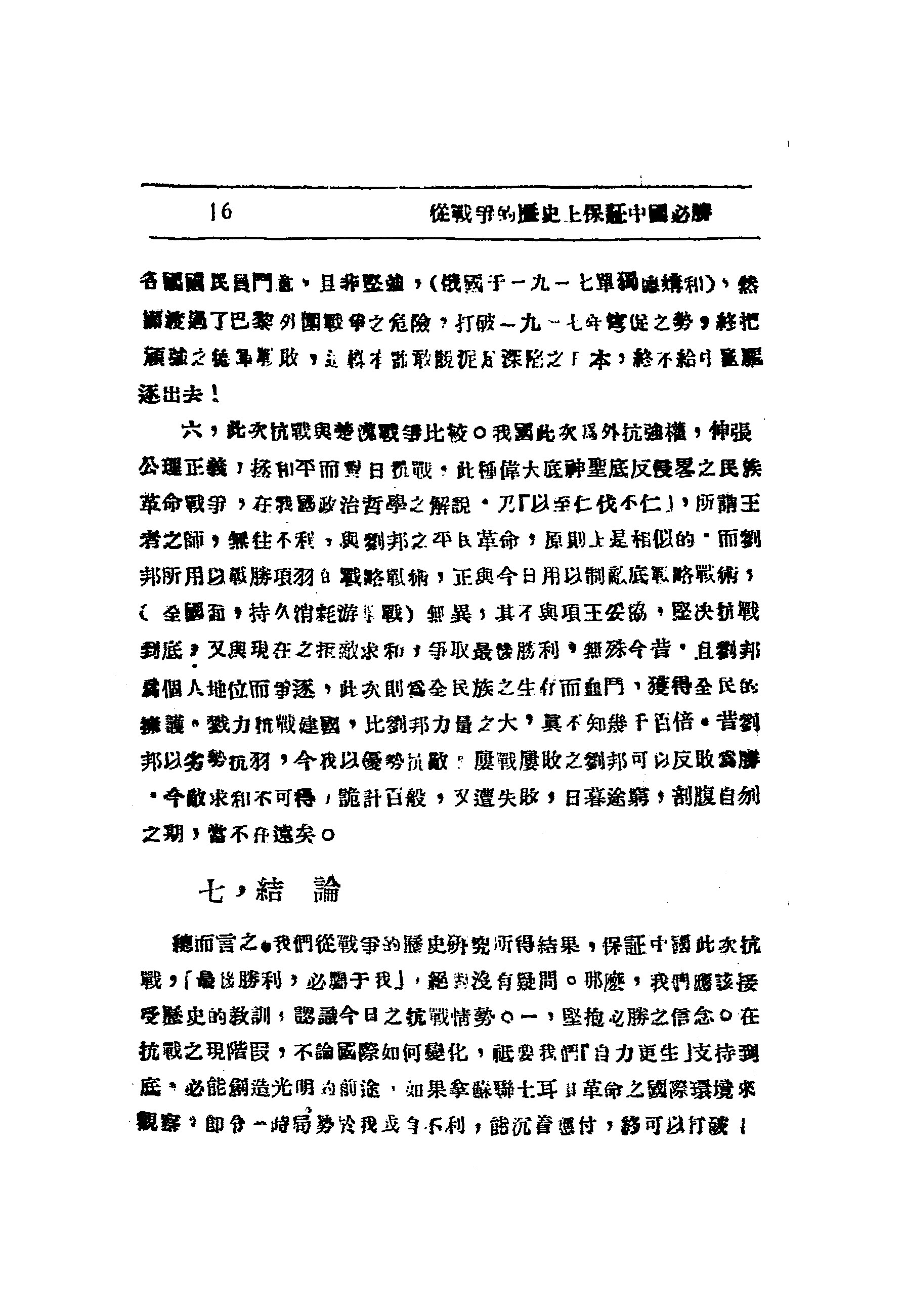
- vs. the Chu–Han war. Japan, like Xiang Yu, opened with apparent superiority and cannot tolerate a long war. China, like the early Han, can absorb defeats and wait. The historical pattern is on China's side.
Conclusion · 結論
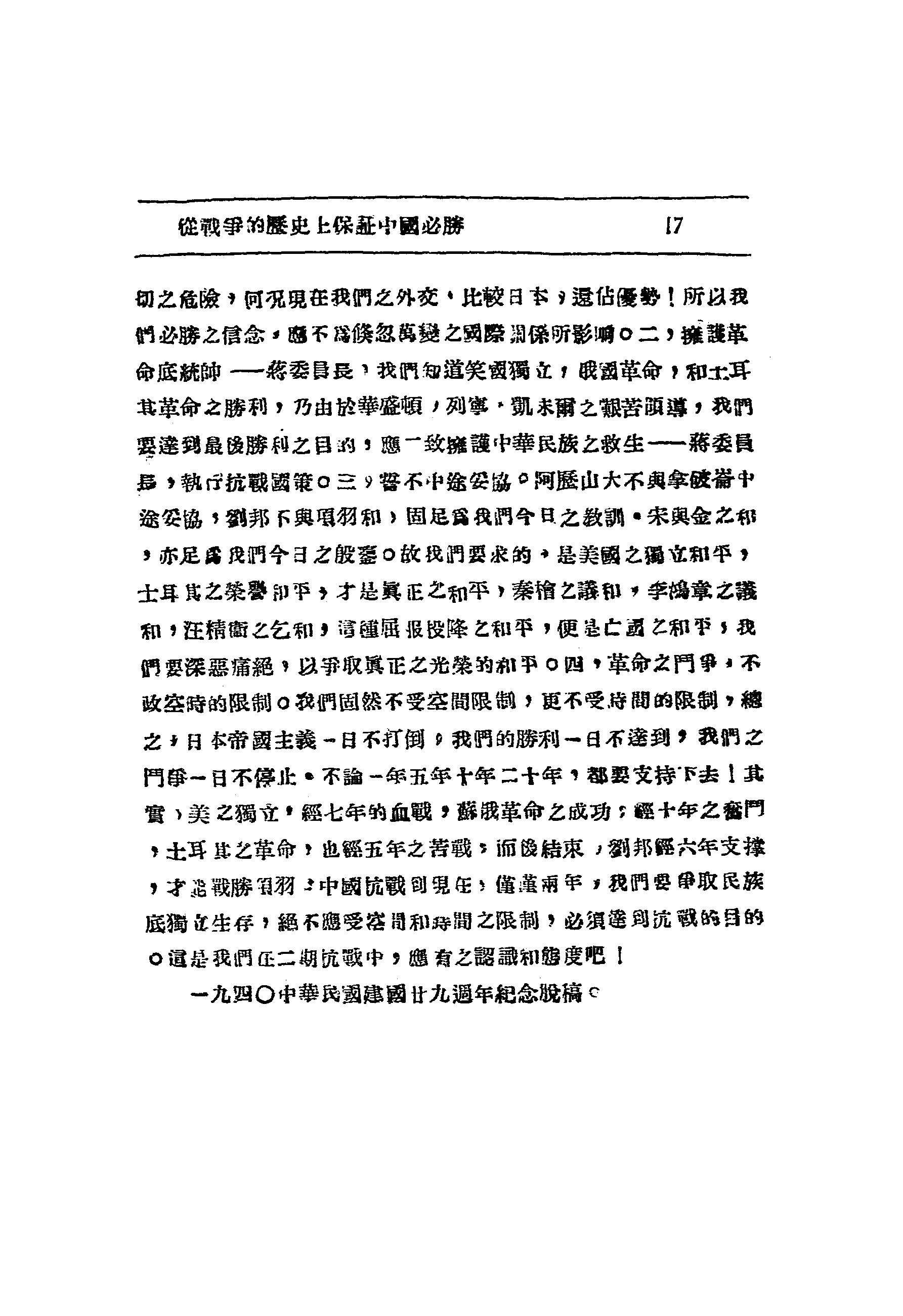
The closing chapter ties the threads together. At the current stage of the War of Resistance — no matter how the international situation shifts — so long as China holds to 「自力更生」(self-reliance, "regenerate by our own strength") and supports the war to the end, a bright future can be created. Even if the external situation turns temporarily against China, the Soviet and Turkish precedents show that calm, patient handling can break the worst encirclement. History, properly read, does not merely permit Chinese victory; it predicts it.
Why this booklet matters
This is a Whampoa-trained Nationalist officer, writing in January 1940 from southern China, publishing a sober comparative-history argument for Chinese victory — at a moment when the official Japanese line was that resistance was already futile and the privately whispered Chinese line, in many places, was the same. The pamphlet is short, cheap (20 cents), and structured to be argued from: each chapter is a usable counter-argument against defeatism. It now sits in the National Library of China's Republican-era documents collection and in the Chinese University of Hong Kong Library Special Collections as part of the public record of what people like Wu Yuan Xing actually believed, said, and printed during the war — alongside the poetry and the editorials.
Full page scans
All 21 pages of the scanned copy held at the National Library of China and the Chinese University of Hong Kong Library Special Collections. Download the original PDF.
Page 1
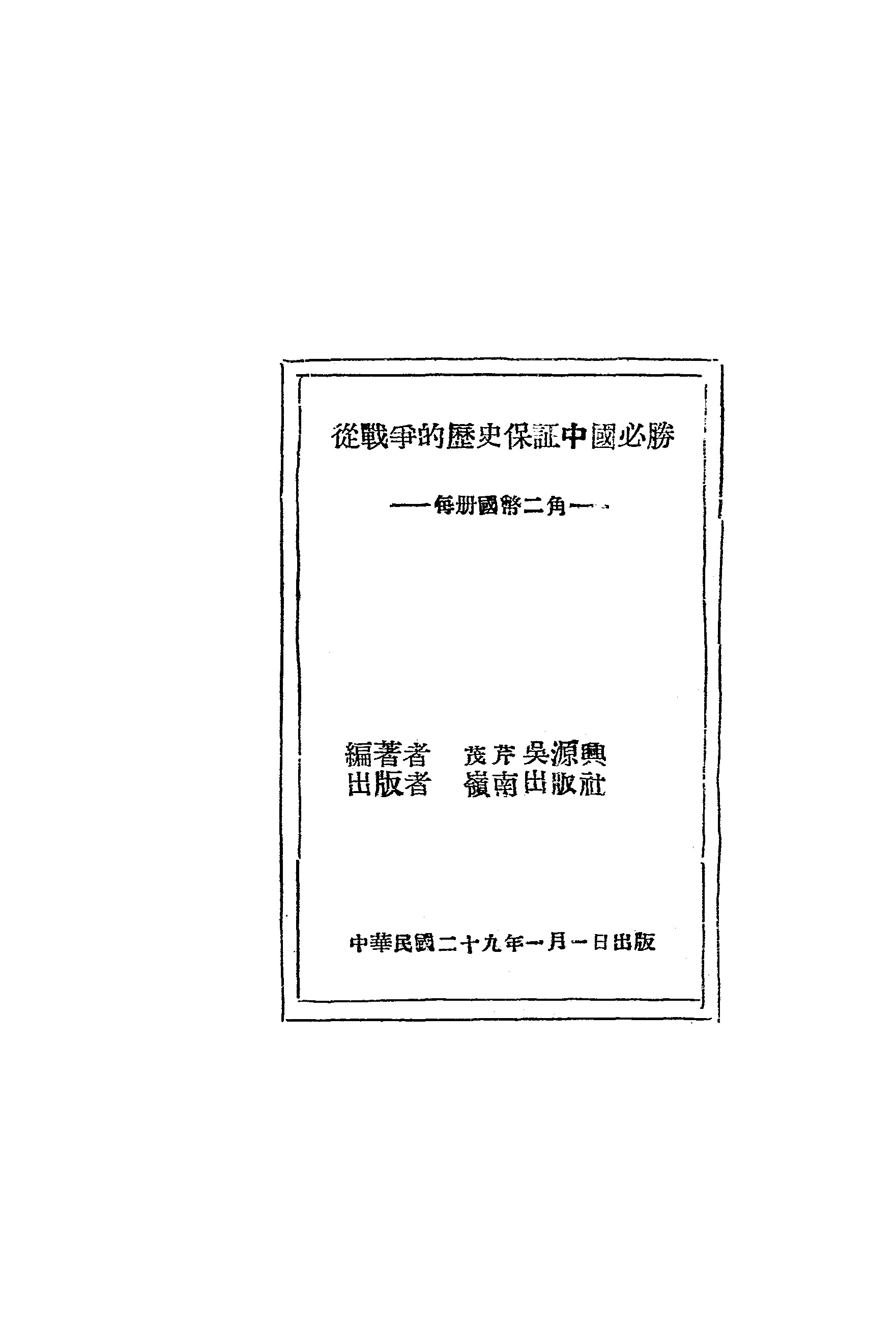
Page 2
Page 3
Page 4
Page 5
Page 6
Page 7
Page 8
Page 9
Page 10
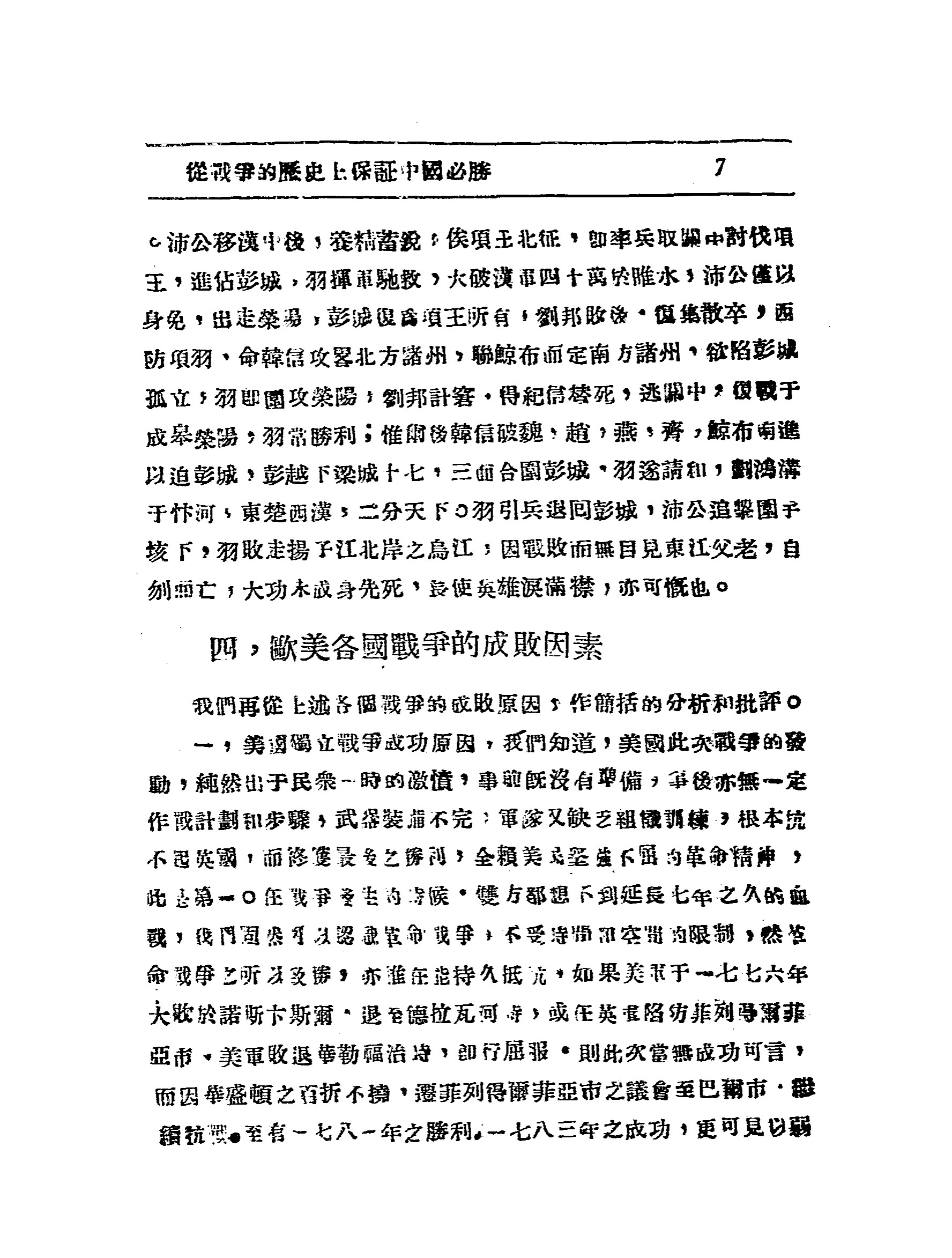
Page 11
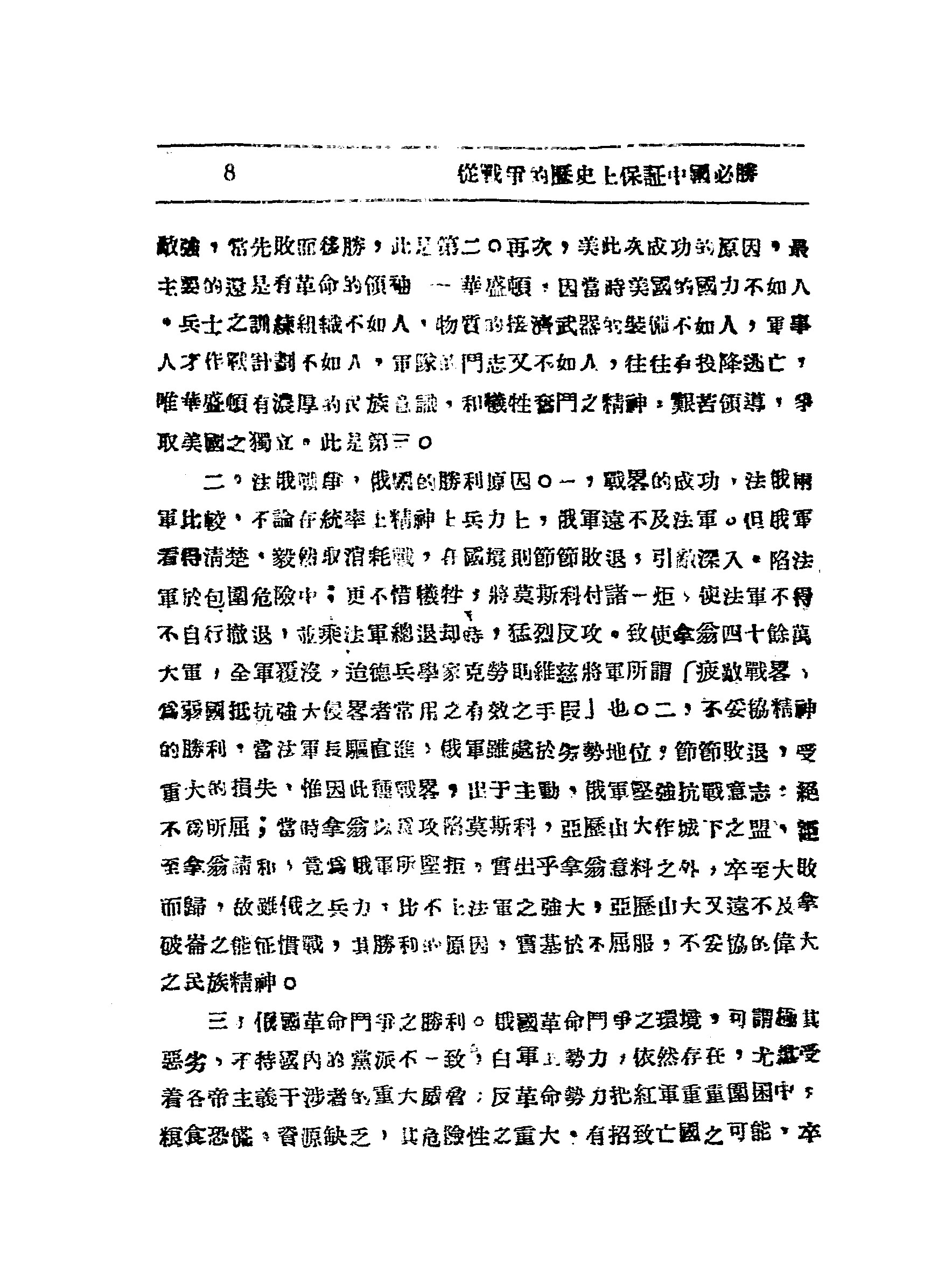
Page 12
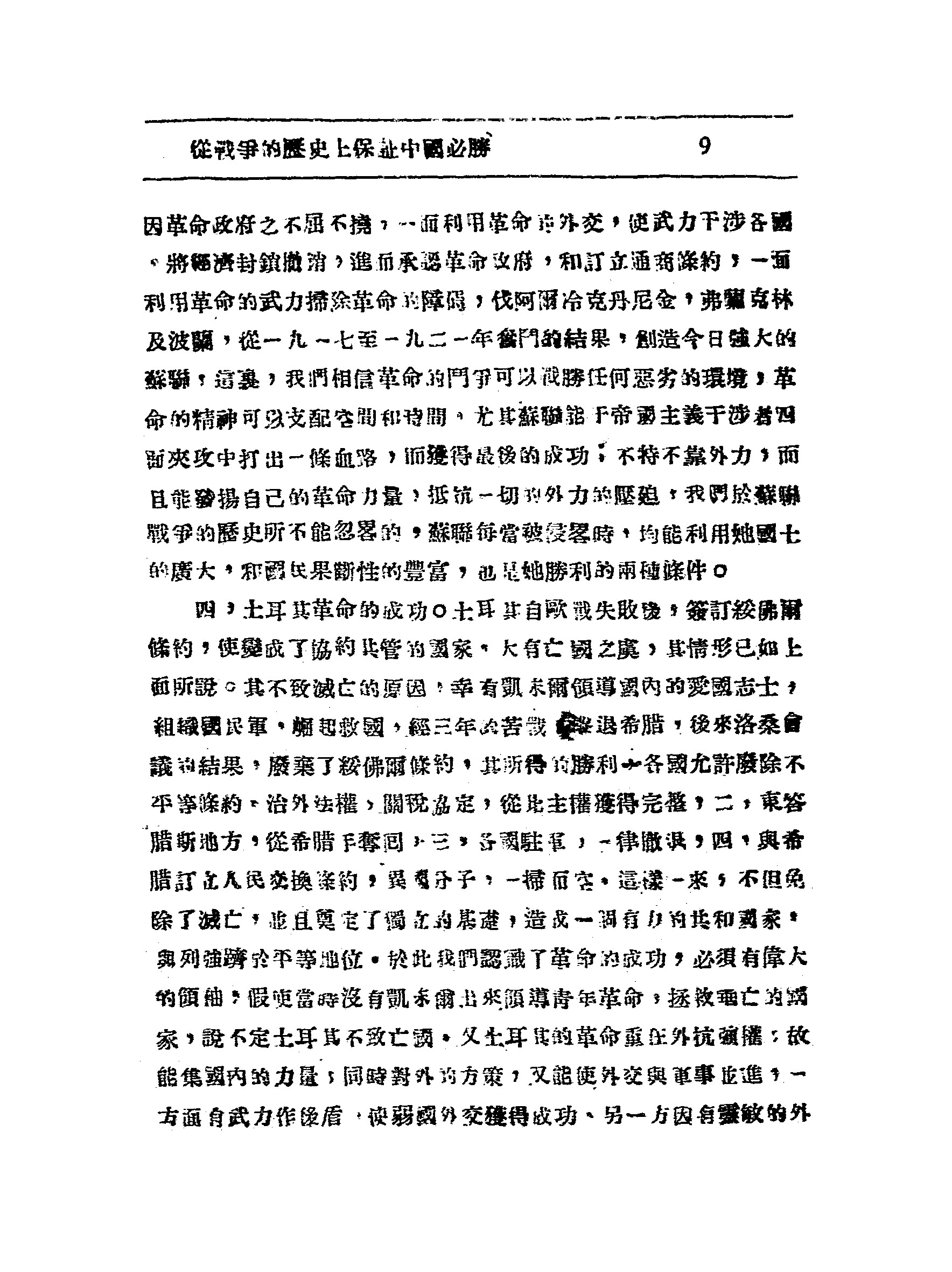
Page 13
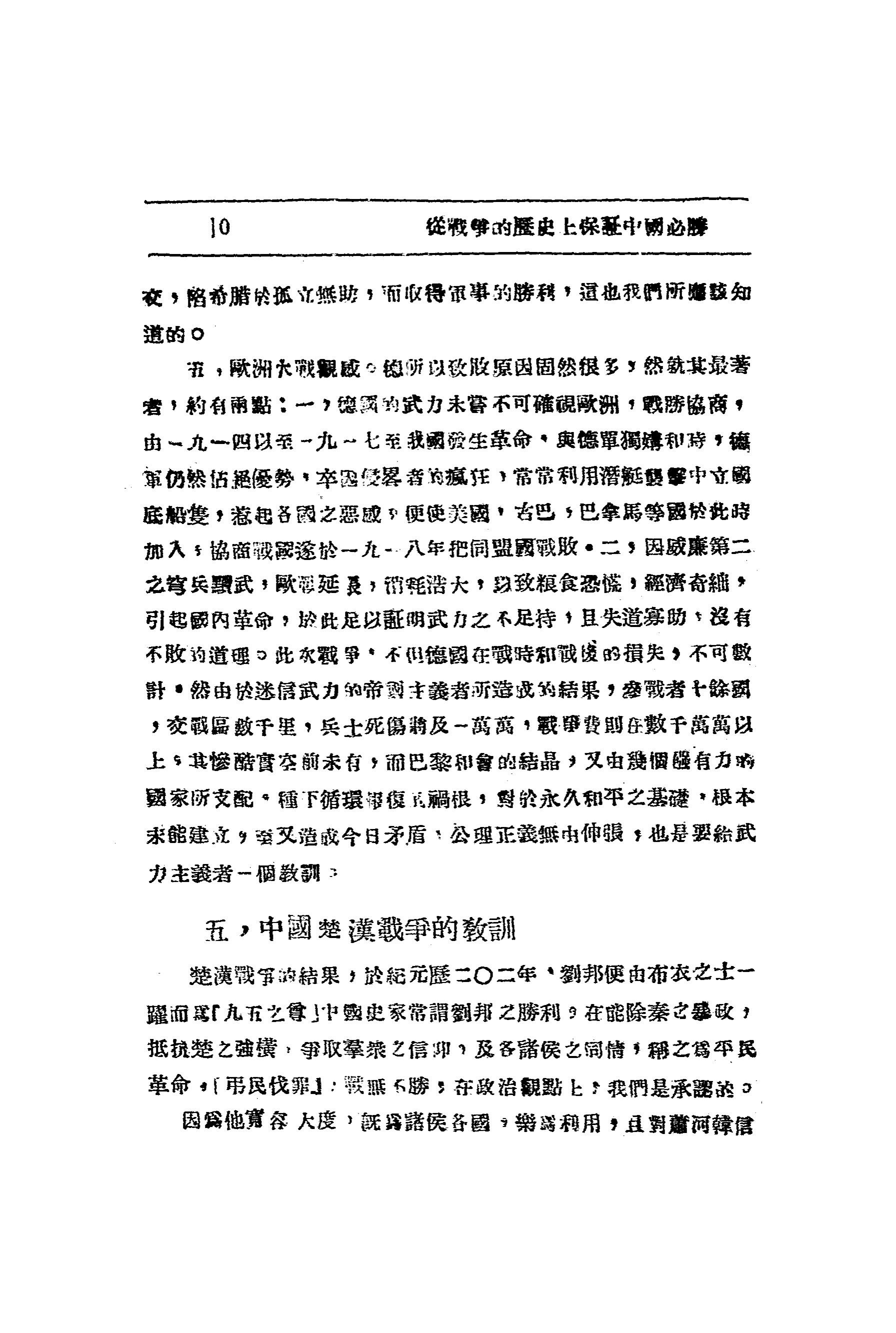
Page 14
Page 15
Page 16
Page 17
Page 18
Page 19
Page 20
Page 21